Introduction
위치 | 미국, 일리노이주, 시카고, S Woodlawn Ave, 5757
용도ㅣ주거
대지 면적ㅣ1,214㎡
층수 | 1F – 3F
Location | 5757 S Woodlawn Ave, Chicago, IL USA
Programㅣresidential
Site Areaㅣ1,214㎡
Floors | 1F – 3F
Agenda
로비하우스는 자연과의 조화와 유기적인 건축을 강조한 ‘프레리 양식’이 잘 드러나는 프랭크 로이드 라이트의 작품이다. 이러한 점이 현대에도 중요한 건축적 가치와 맞닿아 있다고 생각했다. 이에 더해 로비하우스는 돌출지붕과 동서로 길고 낮은 매스가 만들어내는 특징적인 비례감이 있다. 또한 미국에서 타설 콘크리트로 지어진 최초의 주택 중 하나며 연속된 띠창과 코너창, 돌출지붕, 부속 차고등의 건축적 요소들을 대중화 한 작품이라는 점이 이 작품을 선택하는 이유가 되었다.
The Robie House is a seminal work by Frank Lloyd Wright that epitomizes the ‘Prairie Style,’ emphasizing harmony with nature and organic architecture. I thought these principles are considered as important values these days. Furthermore, The Robie House possesses a distinctive sense of proportion derived from its cantilevered roof and its lowrised mass that extends from east to west. Also, it has historical significance as one of the first residential architectures built with cast concrete and as a trendsetting architecture that make elements like cantilevered roof, corner window, ribbon window and attached garage popular. These things make me select The Robie House for case study.
Process
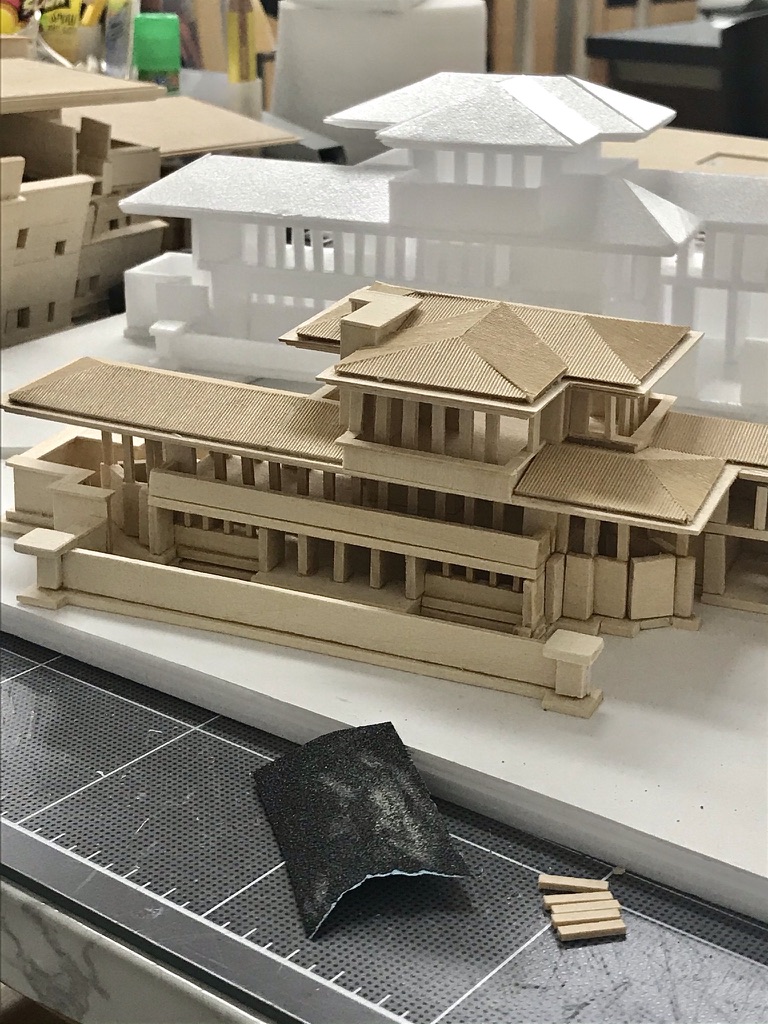
로비하우스의 평면은 동서로 긴 매스 두개가 남북으로 엇갈려 붙어있는 형태이다. 남쪽의 매스는 가족들의 공용공간이 있고 북쪽은 서비스공간을 두었다. 1층을 만들면서 집중했던 것은 이러한 공간의 위계와 동선을 도면과 모형을 통해 느끼는 것이었다. 또한 프랭크 로이드 라이트는 이 집의 남서쪽 사거리에서 보는 건물이 주요 입면으로 인식되기를 바라면서 디자인을 했다고 한다. 이에 따라 남쪽 입면에는 건축가의 디자인적 의도가 잘 담겨있는 공간이 있을것이라 생각했고 1층의 해당 공간인 담장과 연속된 띠창으로 둘러싸인 외부공간을 신경 써서 제작했다.
The plan of the Robie House features two elongated east-west masses that are offset and interlocked along a north-south axis. The southern mass is dedicated to the family’s communal living spaces, while the northern mass houses the service and utility functions. In developing the first floor, my primary objective was to physically and analytically experience this spatial hierarchy and circulation through the process of making drawings and physical model. Frank Lloyd Wright wanted the southwest side of the building to be perceived as the main facade. Based on this, I thought that the southern elevation would be the most expressive of the architect’s intent. Consequently, I paid attention to the first-floor outdoor space, which is made by fence walls and the continuous ribbon windows.

2층의 남쪽 매스는 1층의 공용공간 보다 조금 더 사적인 공간인 거실과 다이닝으로 이루어져있다. 거실과 다이닝은 각각의 실로 구분된 것이 아니라 중앙의 벽난로와 계단으로 간접적으로 분리되어있으며 이는 1층에서도 볼수 있는 유기적인 평면 형태이다. 북쪽매스의 서비스 공간은 다이닝에서 홀을 통해 진입 할 수도 있지만 1층에서 올라올수 있는 동선이 따로 두개나 마련되어있어 두개의 매스를 분리하고자 하는 의도가 있는 것 같았다. 서쪽과 남쪽에 포치와 발코니를 두어 셋백된 2층 외벽과 리듬감이 느껴지는 연속창으로 구성된 리본 윈도우, 뱃머리 모양의 벽체에서 연장된 캔틸레버 지붕까지 모든 요소가 남서쪽 거리에서 수평적 비례감이 지속적으로 강조될 수 있게 구성되었다고 느꼈다.
The second floor of the southern mass comprises the living and dining rooms—spaces that are more private than the communal areas on the first floor. Rather than being partitioned into discrete rooms, these spaces are indirectly separated by a central fireplace and staircase, an open plan strategy that can be found on the first floor. The service areas in the northern mass are accessible from the dining room through a hall. However, two independent circulation from the first floor of the northern mass may suggest a deliberate intent to separate the two masses. From the exterior, every element—the porches and balconies on the west and south, the recessed second-floor walls, the rhythmic ribbon windows, and the cantilevered roofs extending from prow-shaped walls—converges to maintain a continuous emphasis on horizontal proportion as viewed from the southwest street corner.

3층은 침실이 모여있는 층으로 1층에서의 메인 계단인 벽난로쪽의 계단이 아닌, 남북의 매스가 겹치는 부분에 있는 계단으로 진입하게 되어 있었다. 이는 한번에 계단실으로만 계단실을 오르지 않고 공용공간을 한번 거쳐 침실로 가게 하는 건축가의 의도가 있는지 궁금해졌다. 형태적으로는 3층 또한 거리에서 인식되는 입면인 남,서, 동쪽에 모두 발코니를 두어 벽체를 셋백했으며 연속된 창으로 리본 윈도우로 벽체를 둘렀다. 이러한 발코니는 전 층에 거쳐 매스가 계단식으로 셋백되어 수직적인 위압감을 주지 않게 하면서도 담장과 띠창의 반복으로 건물 전층에 거쳐 수평선이 그려져있는 느낌을 준다는 것을 깨달았다.
The third floor, which houses the private bedrooms, is accessed not via the primary staircase near the central fireplace on the first floor, but through a secondary stair located at the junction where the northern and southern masses overlap. This configuration led me to question the architect’s intent: was it a deliberate strategy to filter residents through the communal living areas before reaching the private quarters, rather than providing a singular, direct vertical shaft? Formally, the third floor reinforces its street-facing presence by incorporating balconies on the south, west, and east elevations, which recess the exterior walls and envelope the volume in continuous ribbon windows. I realized that these balconies create a terraced, stepped-back effect across all levels; this not only mitigates vertical intimidation but also establishes a dominant horizontal datum through the rhythmic repetition of garden walls and ribbon windows throughout the entire structure.

Drawings


Maquette


Panel

credit